Thứ Tư, 13 tháng 7, 2011

Rescue Dog

The more Disney shorts I watch, the more I feel like the eras can be grouped into sets by characters. The late 20s and early 30s were the Mickey/Silly Symphonies era, then we had the Mickey/Donald/Goofy era, the Goofy & Donald era and the post war years are shaping up to be the Donald/Pluto era. Hence, we get another Pluto short in the beginning of 1947, with Rescue Dog.


I was not excited going into this one, because the trope of the rescue dog has been used before, not just by Disney. I’ve seen it in Looney Tunes cartoons as well as modern cartoons, so it’s not that original. Pluto has even done variations on it in other shorts. In case you’re unfamiliar with it, the rescue dog is that dog in the snow with a barrel around their neck that drips hot liquid into the mouths of frozen travelers to warm them up in the frozen wastelands.


As discussed yesterday, there is a conundrum of how Pluto can appear in shorts, because he’s at his best when he is a little mischievous. Being a rescue dog takes that away from him, so it’s hard to see how Rescue Dog is going to be good. The story pits Pluto against a seal, who is interested in playing a game with the barrel around his neck.


It’s just not that compelling, frankly. The seal and Pluto cannot talk, so the short is reliant on action to convey the story. There’s not enough action or gags in the short to make it work. On top of that, the seal is not a great character. I had to watch the short twice to understand whether the seal was malicious or just playing around (It’s the latter).


The final sequence of the short offers a different twist, as it’s Pluto who crashes through the ice and is in danger of freezing. The seal goes through a variety of actions to try and save Pluto, finally pulling him out of the water frozen solid.


It’s a neat idea, but the scenes of Pluto swimming around under the solid ice are frankly a bit frightening and unnerving. Even though I knew Pluto would make it, it was hard to watch him struggle like that. The ultimate resolution of the two characters as friends was telegraphed from the beginning, so it lacked an emotional punch. Not the best Pluto short I’ve ever seen, to be sure.


All images copyright Disney.  All rights reserved.

Thứ Ba, 12 tháng 7, 2011

Pluto's Housewarming

Hard to believe that we are starting 1947 on Disney Film Project, covering 25 years of Disney films and shorts in about two and a half years. But that’s where we are, as we take a look at Pluto’s Housewarming, the first short in 1947’s slate of Disney projects.


As Pluto shorts go, this one is pretty standard fare, with Pluto trying to move into a new doghouse but getting some resistance along the way. Apparently this new doghouse is right on the beach, so kudos to Pluto for scoring some fine real estate. Seriously, though, the entire background consists of a couple of scenes of sand, which is kind of weird.


The first obstacle to Pluto’s move is a turtle that takes up residence in the house first. The plucky little turtle conveys a sense of attitude and confidence that makes him endearing, even as he is shoving the “hero” of the piece out of the way. It’s a problem that Disney has always had with Pluto.


When Pluto is behaving himself, he’s not that exciting. When Pluto is being a little more mischievous, he is not the hero of the piece so it’s difficult to root for him. So the question becomes how to toe the line between those two things and make Pluto a compelling character? Pluto’s Housewarming does a good job of that with the turtle and then turning right around and introducing someone who is worse than Pluto.


Butch the bulldog returns to the scene in this one, as a squatter in Pluto’s new home. His introduction right in the middle of the short gives a better villain to deal with, but it’s not Pluto who does it. Instead, the turtle takes issue with the bulldog rather than Pluto. This David v. Goliath sort of confrontation adds some real humor and excitement to the proceedings.


It’s fairly easy to see where this is going, right? Pluto and the turtle end up together, because they have a common foe. It makes Pluto more sympathetic and preserves the turtle’s energy from earlier in the short. That’s fun. And it makes Pluto’s Housewarming into an enjoyable, but predictable little short.

Thứ Năm, 7 tháng 7, 2011

Double Dribble

We end 1946 with one of my favorite subjects.  Goofy sports themed cartoons are one of my great pleasures in life. There were fewer of them than most people think, and the highlight of them all is definitely Hockey Homicide. Today’s subject, Double Dribble, is also a fantastic addition to the series, and features some new tricks for the old dog.


Once again, we’re presented with multiple Goofs, making up both sides of the coin in a basketball game. This one relies on simple gags, such as the Goofs slapping each other during the jump ball tip off. That gag is repeated several times throughout, and though it doesn’t get funnier each time, it’s certainly amusing.


The thing that lends this short a little extra fervor, though, is the addition of a small story that weaves throughout the proceedings. The first shots of the teams show us a smaller Goofy, who struggles for playing time against the behemoths who make up the larger team. He becomes the relatable character in this slapstick festival, and makes the whole thing more entertaining.


As I said, the devices used, such as the omniscient narrator, the overhead shots of the dots skipping along the playing surface and the “illegal” play are all familiar. They were used in other Goofy shorts. They’re amusing here, but that little guy makes all the difference. While you watch the other characters, you root for him to get off the bench and join the fun.


When the little Goof jumps off the bench, the reactions of the other players, coach and spectators are fantastic. The players don’t take him seriously, the coach is ready to kill himself and the spectators are laughing. The viewer, though, is simply rooting for him and ready to embrace the key moment.


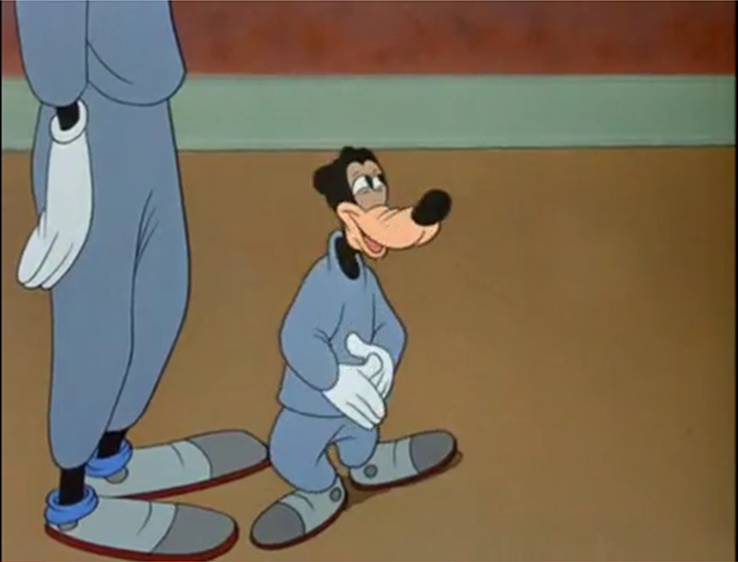
That comes pretty quickly, as we see the little guy steal the ball and win the game, all in inventive fashion, no less. It makes this short feel quicker and lighter than some of the Donald shorts we’ve seen recently and gives Double Dribble a heart to what had previously been a series solely focused on gags and slapstick.

All images copyright Disney.  All rights reserved.

Thứ Ba, 5 tháng 7, 2011

Tweetwatch - Monday, July 11 - The Many Adventures of Winnie the Pooh


Once again dear friends, it's time for some Tweetwatchin', to get ready for another major film release from Walt Disney Pictures.  This Monday, we'll go back to the original before getting ready for he sequel, as we Tweetwatch The Many Adventures of Winnie the Pooh.

This one has some great animation, fantastic storytelling and more.  I'm looking forward to seeing it with you guys.  In case you have not joined a Tweetwatch before, here's the details:

1.  Sign up for our Friendfeed room and/or follow me on Twitter
2.  Go get a copy of The Many Adventures of Winnie the Pooh
3.  On Monday, July 11 at 8:30p ET, jump in the Friendfeed room or on Twitter.
4.  I'll tweet the notice to push play, then we'll watch the movie together.  Throughout, I'll offer facts and details on the movie. 

Join in the fun on Monday, July 11 at 8:30p ET.  See you then!

Chủ Nhật, 3 tháng 7, 2011

Disney Film Project Podcast - Episode 26 - The Country Bears


There's gonna be some blood on the saddle as the DFPP team takes a look at Disney's The Country Bears. Ride along with us as we take a look at the adventures of one of rock and roll's most infamous bands.

Listen, download, etc.

Show notes:

Thứ Sáu, 1 tháng 7, 2011

Song of the South - Should It Be Released on DVD?


I am going to wade into the controversy of Song of the South, probably to my chagrin. However, I don’t know that you can discuss this film intelligently without speaking about Disney’s decision to keep it hidden away. So if you’ve made up your mind on the topic, quit reading now.

Bob Iger, CEO of the Walt Disney Company, recently stated that he had watched Song of the South again, and upon this new viewing he had decided that the material in the film was not suitable for modern audiences. I have two problems with that statement. First, I don’t know that I want Bob Iger deciding what is or is not suitable for me. Second, I don’t know what movie he was watching, but I think Song of the South is important for audiences to see.

The main complaints I have seen about the film are that it does not portray a realistic relationship between slaves and their owners in the South and that the African Americans in the film are stereotypical slave portrayals. Both of these things are absolutely true. However, they are both irrelevant to the question of whether people should see the film.

How is the portrayal of slaves in Song of the South any different than that in Gone With the Wind? If the issue is that of dialect or mannerisms, then why is Song of the South being singled out? There are dozens of films out there that feature slaves portrayed in the same way, yet there is not outcry when Gone With the Wind gets another DVD or Bluray release.

As for the issue of how plantation life is depicted in the film, it’s a valid point. I doubt that most plantations featured slaves who did nothing but sit around and tell stories. I also doubt that Uncle Remus would have gotten away with some of the things he does in the movie. That does not mean that we should not be able to see the portrayal, though.

As I stated in my review of the film, this is a turning point in the history of the Disney studio. It’s not a film that would be acceptable to mass audiences today, and I understand that. But the importance of the film should not be kept from Disney fans who want to connect with the history of the studio.

I will freely state that I am not African-American, so this does not affect me in the same way as those of you who have had to live through discrimination in your life. My stance on this is not to say that others who do not want the film released are wrong in their reasoning or emotion. My feeling, though, is that this movie should be available to those who want it.


It should not be a widely marketed release, an family movie or anything of that nature. Disney should be able to release the film digitally or through some kind of special DVD release that would allow them to place the film in its proper context. Do it tastefully, but release the film. I think if Disney explained it that way, that this was a way to keep the company’s history alive, not exploiting the actors or the situation for a quick buck, then it would be accepted.


What do you think?